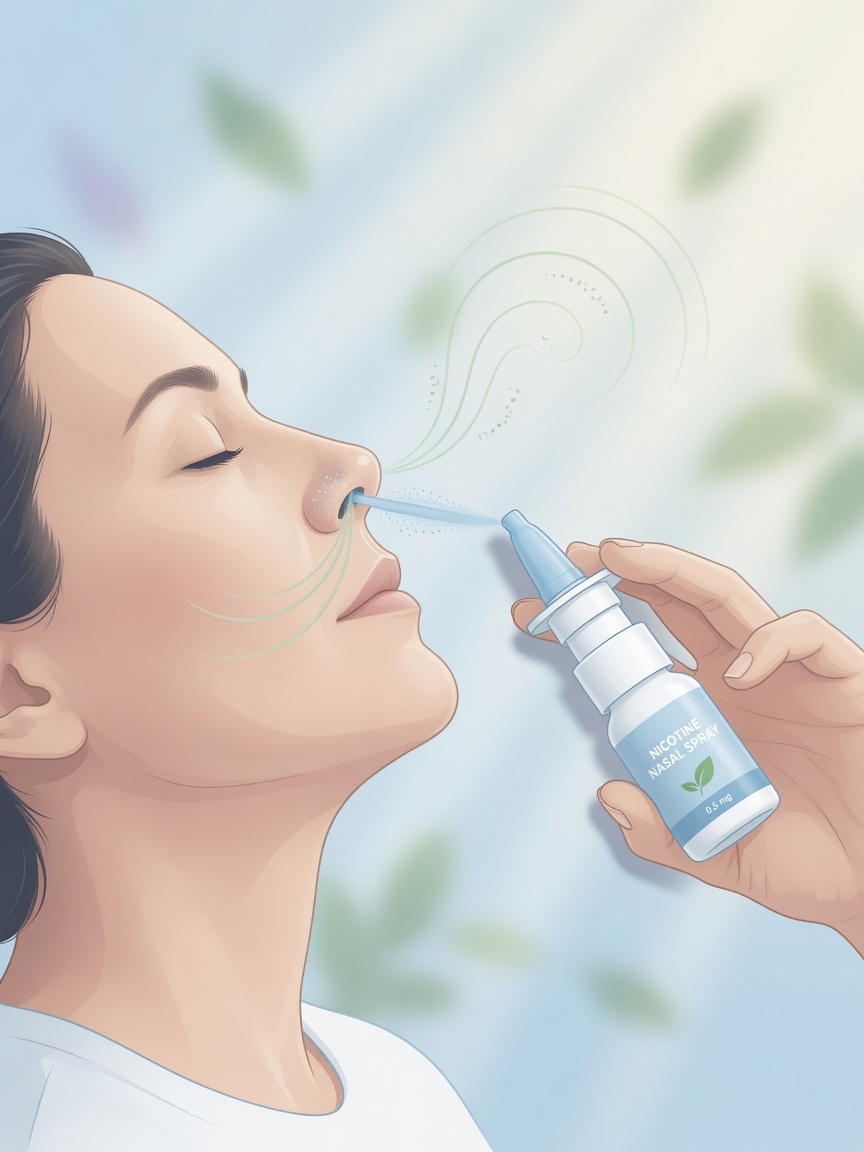
**For those preparing to quit smoking with nasal spray**
This article explains "how to use, how much to take, what reactions to expect, and how to reduce dosage." The content is compiled from publicly available smoking cessation medication instructions and clinical medication consensus for popular science purposes, **and cannot replace a doctor's consultation, prescription, or product leaflet**. Specifications and labeling of approved products may differ by country/region. Please refer to the leaflet of your specific product and your attending physician's advice.
## 1. First Understand: What Role Does Nasal Spray Play in Smoking Cessation Nicotine nasal spray belongs to the **short-acting, fast-onset** dosage form within **Nicotine Replacement Therapy (NRT)**. It delivers nicotine through the nasal mucosa, helping relieve sudden cravings and withdrawal discomfort, thereby reducing your dependence on cigarettes. General differences among common NRT options (for understanding selection, not for self-switching):
| Form | General Characteristics | Common Perceived Use |
|---|---|---|
| Patch | Long-acting, stable blood concentration | Covers "all-day baseline" |
| Gum / Lozenge | Short-to-medium acting, portable on-demand | Covers "predictable cravings" |
| **Nasal Spray** | **Relatively fast onset, on-demand, flexible** | **Covers "sudden intense cravings"** |
| Inhaler etc. | Provides hand-to-mouth action substitute | Covers behavioral habit |
- **During nasal spray use, you should completely stop smoking** (and avoid adding other nicotine products not prescribed). Spraying while smoking makes it hard to judge dosage and increases risk of overdose, often resulting in lower quit rates.
- In many regions, nasal spray is classified as a **doctor-guided/prescription-managed** smoking cessation medication; dosage and course should be individualized.
- **Medication + behavioral support** (planning, trigger management, family cooperation, quit counseling) is generally more reliable than "medication alone."
## 2. Dosage: First Understand "What Is One Dose," Then How Many Times a Day ### 2.1 How to Count One Dose In standard nasal spray instructions, **one dose typically = 1 spray in each nostril** (one per nostril). The specific nicotine content per spray depends on the product leaflet (commonly described as about 0.5 mg per spray, **please check your product**). ### 2.2 Starting and Limits (Principle Framework) Common and widely cited frameworks from public usage guides:
- **Starting**: Most people start at **1–2 doses per hour**, then adjust under medical guidance based on withdrawal symptoms and craving intensity.
- **Daily baseline awareness**: To truly suppress withdrawal, many protocols emphasize **at least about 8 doses per day** (too few often feels "useless"—actually insufficient dosage).
- **Hourly limit**: Common upper limit is **no more than 5 doses per hour**.
- **Daily limit**: Common upper limit is **no more than 40 doses in 24 hours**.
The above numbers come from popular science summaries of classic prescription nasal spray (leaflet-level information).### 2.3 Why "Too Little" and "Too Much" Are Both Wrong
**You must follow your current product leaflet + doctor's prescription; do not copy others' usage.**
- **Too little**: Insufficient nicotine replacement → irritability, poor concentration, strong cravings → higher relapse risk, and mistaken belief that "the medication doesn't work."
- **Too much or combined with smoking**: May cause nausea, palpitations, dizziness, headache and other **nicotine overdose** symptoms; long-term unnecessary high-frequency use also increases risk of **developing dependence on the spray itself**.
- **Stop smoking**: From the start of nasal spray treatment, the goal is to completely quit cigarettes.
- **Do not self-combine multiple nicotine-containing products** unless explicitly arranged by a doctor (e.g., patch + short-acting combination).
- **Carry and use regularly**: Especially the first week, rather than waiting until cravings become overwhelming, use more regularly on schedule to allow a smooth transition.
## 3. Correct Usage Techniques: Step by Step The following steps synthesize common official "how to use" instructions for easier memorization. ### 3.1 Before Use
- **Blow your nose** to clear nasal passages (if severely blocked or acute rhinitis worsened, consult your doctor about delaying or switching forms).
- Check that the nozzle is clean and the cap is on; **keep out of reach of children and pets** (nicotine is dangerous to children).
- Before first use, complete **priming** as per the leaflet (if required).
- **Tilt your head back slightly** (no need for exaggerated tilting).
- Insert the nozzle into one nostril, to a depth that is **comfortable and not painful**.
- **Breathe through your mouth**; while pressing the spray, **do not sniff hard or swallow deeply**.
- Spray once into the other nostril → this completes **1 dose**.
- If instructions suggest directing the spray toward the side wall of the nasal cavity, follow the diagram to help medication adherence and reduce direct throat irritation.
- **Try not to blow your nose for 2–3 minutes**; if slight leakage occurs, you may **gently sniff back** to aid absorption, but do not forcefully sniff.
- Replace the cap and store away from light at room temperature as per leaflet.
- Record approximate time and dose (see checklist at end) for review with your doctor.
| Mistake | Possible Consequence | Better Practice |
|---|---|---|
| Sniffing hard while spraying | Medication reaches throat/airways, more irritation, suboptimal absorption | Breathe through mouth, spray gently |
| Forcefully blowing nose right after | Dose is blown out, reduced effectiveness | Wait 2–3 minutes |
| Only spraying occasionally when "can't resist" | All-day nicotine trough too low, cravings spike repeatedly | Start with scheduled dosage, then adjust per medical advice |
| Smoking while using spray | Overdose risk ↑, cessation logic confused | Stop smoking + standard NRT |
| Persisting with increased dosage despite nasal discomfort | Irritation worsens, compliance collapses | Assess whether to reduce dose, switch form, or seek medical help |
## 4. Common Side Effects: Which Are "Normal in the First Few Days," Which Require Caution ### 4.1 Very Common Local Reactions in the First Week Information repeatedly mentioned in leaflets and health authority materials:
- **Burning, peppery/spicy sensation** in the nasal cavity or back of throat
- **Sneezing, runny nose, stuffy feeling**
- **Watery eyes, coughing**
- Local irritation
- Headache, dizziness
- Nausea, abdominal discomfort
- Palpitations, sleep changes
- Mouth/nose ulcers or increased irritation (less common but needs attention)
- **Severe allergic** reactions such as rash, swelling, difficulty breathing
- **Chest pain**, severe palpitations, fainting
- Uncontrollable nosebleeds, severe nasal pain, or noticeable worsening of existing sinus/nasal polyp issues
- Notable mental status abnormalities, or if you cannot determine whether it is safe
## 5. Dependency Transfer: What If You "Quit Smoking but Can't Quit the Spray" ### 5.1 Set Correct Expectations First
- Nicotine nasal spray **can produce some dependence** (the medication information also carries such a note).
- But compared to continued smoking: you avoid the **tar, carbon monoxide, and thousands of harmful combustion products** from burned tobacco—this is NRT's core harm reduction logic.
- The treatment goal is not "to live on the spray forever," but: **use a controlled, gradually reduced nicotine bridge to safely reach a state of not smoking and ultimately not depending on the spray**.
- Planned dosage and timing
- Matches the cessation stage (sufficient in early weeks, tapering thereafter)
- Cravings decrease after spraying, allowing continued work and life
- Willing to reduce dosage as directed
- Spraying "just because" even without cravings
- Using the spray to cope with all emotions (boredom, anxiety, overtime) without learning substitute behaviors
- Dose not decreasing but increasing, or extreme panic when stopping yet refusing follow-up adjustments
- Treating the spray as a "pick-me-up" rather than a cessation tool
- **Set a treatment mindset from day one**: e.g., agree on a total treatment framework and review schedule with your doctor.
- **Record triggers**: what times and situations make you most want to spray or smoke (after meals, driving, after arguments).
- **Find other outlets for emotions**: drink water, deep breathing, briefly leave the scene, non-nicotine gum, a 3-minute walk, etc.
- **Don't skip behavioral support**: cessation clinics, counseling, reliable quitlines, peer support.
- **Accept mild discomfort during tapering**: a slight "empty feeling" doesn't mean you must immediately return to a high dose; but if withdrawal is severe, adjust the pace rather than tough it out until relapse.
## 6. How to Gradually Reduce Dosage: An Executable Timeline Framework Below is a **popular science-level stage framework** based on common prescription information (classic descriptions often suggest: full use for about 8 weeks, then gradual reduction over about 4–6 weeks, total course around 3 months—**follow medical advice**). ### Stage A: Initiation and Stabilization (Approximately Weeks 1–6/8) **Goal:** Completely stop smoking + suppress withdrawal with sufficient dosage, making "getting through a full day without smoking" the new normal. Recommended actions:
- Achieve adequate daily dosage as prescribed (many people need close to "no less than about 8 doses per day" for effective use, not skimping).
- Stick to regular use during the first week to adapt to local irritation.
- Simultaneously address behavioral habits (discard ashtrays and remaining cigarettes, inform colleagues you're quitting, avoid high-risk drinking occasions, etc.).
- Simple daily check-in: number of doses, strongest craving moment, whether you relapsed.
- **First cut "preventive extra sprays"**: keep doses for strong cravings, remove "spraying for no reason."
- **Lengthen intervals**: e.g., from about 1 dose per hour gradually to every 1.5–2 hours, then reassess.
- **First cut low-risk times**: reduce during smooth morning work, keep doses for high-pressure times like after meals and commuting.
- **Observe 3–7 days after each reduction**: if sleep, mood, concentration, or craving scores noticeably worsen, pause further reduction, or slightly increase and then reduce more slowly.
- **Sync with your doctor**: blood pressure medications, psychiatric medications, and chronic condition changes may all affect tolerance.
- The 1–2 weeks around discontinuation are a high relapse risk period; continue using behavioral strategies.
- If strong cravings persist after stopping, **follow up promptly** to discuss extending the taper, a short-term step-back, or switching plans—this is far safer than "secretly trying one cigarette."
- During consolidation, watch weight, oral health, sleep, and mood; they are often mistaken as excuses that "smoking feels better," but most can be improved through non-smoking methods.
- **Don't attack yourself**: self-blame drives the next round of "might as well give up."
- **Restart the plan within 24 hours**: identify triggers, patch behavioral gaps.
- **Honestly tell your doctor/supporter**: whether NRT adjustment is needed.
- **Distinguish "one slip" from "returning to regular smoking"**: the earlier you interrupt, the easier it is to get back on track.
## 7. Combination Therapy and Special Considerations ### 7.1 What Works Well Together
- **Strongly recommended**: behavioral counseling, cessation programs, informed family support.
- **May be recommended (under medical advice)**: long-acting patch + short-acting nasal spray combination for heavily dependent individuals.
- **Caution needed**: simultaneously using multiple self-purchased nicotine products, energy-enhancing vaping liquids, or unregulated "quit-smoking gadgets."
- Frequent rhinitis, acute allergic rhinitis episodes
- Nasal polyps, severe septal issues, chronic sinusitis
- Asthma or other reactive airway diseases
- Recent nasal surgery or unhealed nasal mucosal damage
- Store strictly according to leaflet temperature and sealing requirements.
- **One accidental ingestion can be fatal to a child**; recap immediately after use and lock it up high.
- Do not lend the bottle to friends also trying to quit—dosage and indications vary by individual.
## 8. Practical Checklists (Recommended to Save) ### 8.1 10-Point Pre-Start Checklist
- [ ] Consulted doctor/pharmacist, confirmed suitable for nasal spray
- [ ] Read and retained product leaflet
- [ ] Set a quit date, removed cigarettes and lighters
- [ ] Know that "one dose = one spray per nostril" (or as per leaflet)
- [ ] Noted hourly/daily limits to avoid overdose
- [ ] Prepared a recording method (phone notes works)
- [ ] Informed family you are using NRT to avoid accidental handling
- [ ] Set behavioral alternatives (drinking water, leaving smoky environments, etc.)
- [ ] Know what to do if chest pain/severe allergy occurs
- [ ] Scheduled a follow-up or self-review in 1–2 weeks
- Date:
- Total doses today:
- Strongest craving moment & situation:
- Nasal irritation score (0–10):
- Mood/sleep brief notes:
- Smoked today? (yes/no; if yes, how many):
- Tomorrow's plan adjustment:
## 9. Quick FAQ **Q: The irritation is too uncomfortable. Should I stop using it?** A: Common in the first week. First check if you are "sniffing hard" while spraying. If still severe after a week, contact your doctor; adjustment or switching forms may be needed. Don't tough it out alone. **Q: Can I only spray when I feel like smoking?** A: On-demand use is possible, but many failed cases involve "using too little." Early on, more regular and sufficient dosing is often needed before transitioning to on-demand use. **Q: Will I become dependent on the spray for life?** A: Dependence is possible, but standard treatment emphasizes staged reduction. The dependence risk is generally still lower than continued smoking; the key is to combine behavioral change and complete the taper. **Q: Can I still spray with a stuffy nose from a cold?** A: Nasal congestion clearly affects absorption and comfort. Consult your doctor about whether to pause, reduce dosage, or temporarily switch to another NRT. **Q: Is it better to use it together with e-cigarettes?** A: Self-combining is not recommended. E-cigarettes can also maintain nicotine dependence, and products/dosages are harder to standardize, likely disrupting the cessation path. Stick with evidence-based cessation medication and behavioral support.
## 10. One-Sentence Summary **Under medical guidance, use sufficient dosage to completely replace smoking, get through the first few days of irritation with correct spraying technique, and follow an executable tapering plan toward "not smoking and not depending on the spray"—that is the correct way to use nicotine nasal spray for smoking cessation.**
## Disclaimer This article is a public health popular science and educational material to help readers understand the general usage logic, common reactions, and tapering approach of nicotine nasal spray. The dosage ranges, treatment stages, and operational points are compiled from publicly available medication instructions and cessation health education resources, **and may differ from specific brands, approvals, or national/regional regulatory requirements**. Any decision to start, adjust, combine, or discontinue should be made under the guidance of qualified medical professionals, considering personal medical history, current medications, and the product leaflet. The author and publisher assume no responsibility for consequences of self-medication. If you are experiencing an emergency (chest pain, difficulty breathing, severe allergies, etc.), seek emergency medical care immediately.
*Document type: Smoking Cessation NRT Usage Guide (Popular Science)* *Recommended save path: Foundational Preparatory Articles / Generated Articles* *Companion prompt: `_task_prompt_nicotine_nasal_spray_guide.txt`*